690+
Inspect verification sourceAutomated Tests (Py 3.10–3.13)
Full unit, integration, security, and phase-gate suite running on a Python 3.10–3.13 CI matrix alongside Ruff, mypy, pip-audit, and Gitleaks secret scans.
Deployment model: Docker Compose + Caddy TLS · GitHub Action · Stdio MCP
Zero-token static/AST pre-scans + 3-agent CrewAI Flows crew + plain-code deterministic reconciler, durable SQLite WAL queue, 8 MCP tools, and 690+ automated tests.
A full-stack multi-agent pull request review platform (React 19 Workbench, FastAPI webhook gateway, CLI, reusable GitHub Action, GitLab/Bitbucket adapters, and stdio MCP server) that runs deterministic scanners and AST call-graph indexing before LLM calls, reconciles findings in plain code, and ships with 690+ automated tests across Python 3.10–3.13.
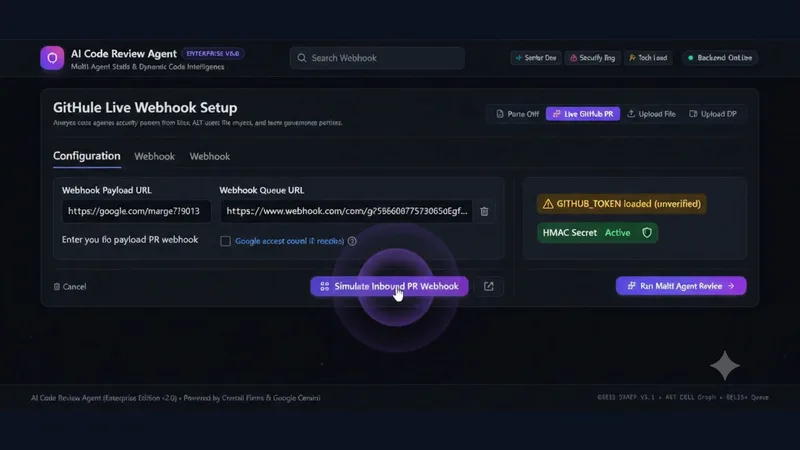
Repository-Backed Evidence
Full unit, integration, security, and phase-gate suite running on a Python 3.10–3.13 CI matrix alongside Ruff, mypy, pip-audit, and Gitleaks secret scans.
Matches by file, exact line, and defect type — counting every unmatched hit as a false positive (18 TP, 0 FP, 0 FN; upgraded from an initial 79.2% baseline). Scoped synthetic regression fixtures, not universal accuracy across arbitrary external codebases.
Stdio MCP server exposing 8 review tools to Claude Code & Cursor, plus 15 PR slash commands with author-association RBAC across GitHub, GitLab, and Bitbucket.
100.0% complete deterministic capture across 20 frozen real Flask pull requests (24 sourced findings, 3.72s mean PR latency; human adjudication tracked separately).
End-to-end dataflow and defensive isolation layers from request entry to verified output.
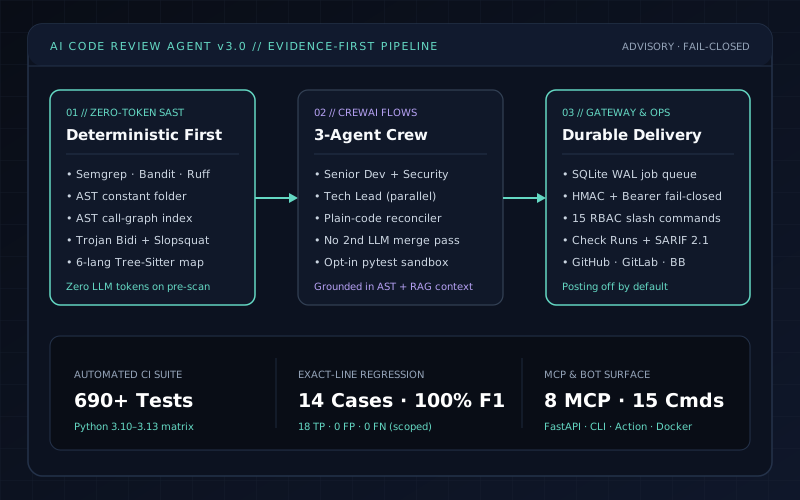
Layered engineering safeguards designed so no single model call is the sole boundary.
Semgrep, Bandit, Ruff, a custom AST constant folder, Trojan Source Bidi stripping, supply-chain slopsquatting checks, YAML policies, and a 6-language Tree-Sitter call-graph index all run before any LLM call — strictly limiting what agents can claim.
Runs Senior Developer, Security Engineer, and Tech Lead agents in parallel via CrewAI Flows with provenance guardrails. A reconciler written in plain Python deduplicates findings and computes confidence from a documented rubric instead of a second LLM pass.
FastAPI gateway backed by a durable SQLite WAL job queue with HMAC webhook verification, fail-closed Bearer auth, orphaned-job recovery, and SSE streaming to a React 19 Live Annotated Source Viewer.
Exposes 8 review tools over stdio MCP to Claude Code & Cursor, ships 15 PR slash commands with author-association RBAC across GitHub/GitLab/Bitbucket, and includes a Tricorder-style circuit breaker + 690+ tests on Python 3.10–3.13.
AI coding assistants generate clean-looking code that still slips SQL injection, plaintext password checks, hallucinated dependencies, unawaited async auth checks, and invisible Unicode tricks past basic linters. Pure-LLM reviewers add ungrounded noise without deterministic file/line evidence or cross-file call context.
Built the full platform end-to-end: zero-token deterministic pre-scan layer (Semgrep, Bandit, Ruff, custom AST constant folder, Tree-Sitter call-graph index, YAML policy engine), parallel 3-agent CrewAI Flows crew with plain-code deterministic reconciler, FastAPI gateway + durable SQLite WAL job queue with HMAC auth & orphaned-job recovery, 15 PR slash commands, 8-tool MCP server, React 19 Live Annotated Source Viewer, GitHub Action + GitLab/Bitbucket adapters, SARIF v2.1.0 export, and 690+ automated tests across Python 3.10–3.13.
Step through concrete scenarios to see how the system checks boundaries, reproduces failures, or degrades under quota pressure.
PR diff adds hallucinated package `flask-auth-helpers` + `subprocess.run(shell=True, input=user_input)`.
Step 1 / 4
Strip Unicode Bidi characters, validate HMAC/Bearer auth, and scan dependency manifests.
Key design choices, technical rationale, and accepted trade-offs behind the implementation.
Semgrep, Bandit, Ruff, custom AST constant folding, Trojan Source stripping, and Tree-Sitter call-graph indexing all execute at zero token cost before any LLM runs.
A plain-code reconciler deduplicates parallel outputs from the 3-agent CrewAI Flows crew and computes confidence from a documented rubric.
HMAC-validated webhooks, fail-closed Bearer auth, repo allowlists, and off-by-default comment posting / auto-remediation prevent accidental spam or false approvals when an analyzer fails.
Watch the narrated system walkthrough below, or clone the repository to run the complete Docker Compose + Caddy TLS · GitHub Action · Stdio MCP setup and automated test suite locally.
Reliable AI developer tools spend their engineering budget on deterministic pre-scans, plain-code reconciliation, durable queues, and 690+ regression tests — treating LLMs as bounded collaborators inside verifiable guardrails.
Roles & Technical Collaboration
I’m open to full-time remote GenAI & AI Systems Engineering roles, as well as focused architecture and evaluation engagements.