90
Inspect verification sourceAutomated Tests Passed
60 backend API & RBAC tests, 5 rate-limiting & role-scoped cache resilience tests, 20 OWASP security regression tests, and 5 frontend NDJSON stream tests.
Deployment model: Docker Compose Full Stack (FastAPI + React + Redis)
3-layer RBAC (0.93 security score, 0 filter leaks), 3-way query expansion + ChromaDB/FTS5/Cohere RRF, sandboxed in-memory DuckDB SQL, <20ms Redis cache, and 90 automated tests.
A full-stack enterprise RAG and Text-to-SQL workspace (FastAPI + React 19 + TypeScript + Docker Compose) where every department's documents and CSV tables stay scoped to authorized roles across 3 access layers, repeat queries replay in under 20ms via role-scoped Redis caching, and dual-track evals + 90 automated tests verify both quality and security.
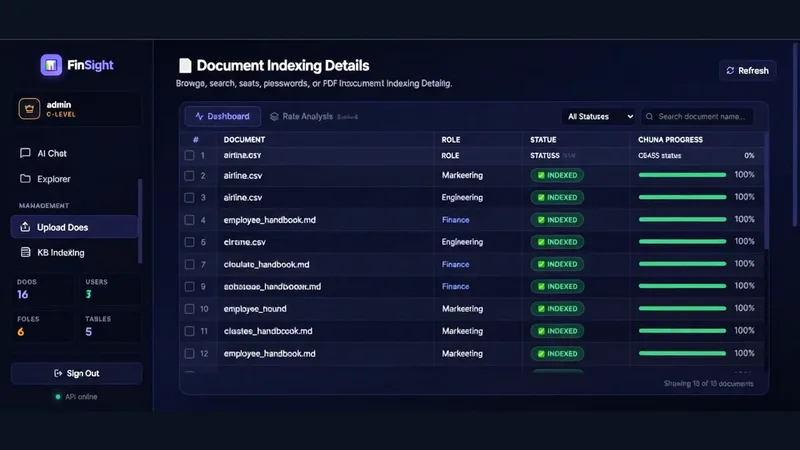
Repository-Backed Evidence
60 backend API & RBAC tests, 5 rate-limiting & role-scoped cache resilience tests, 20 OWASP security regression tests, and 5 frontend NDJSON stream tests.
6 automated RBAC security tests across 6 roles scoring 0.933 overall with zero ChromaDB metadata-filter violations and 100% authorized access accuracy.
Repeat-query latency under 20ms via SHA-256 role-scoped Redis cache (automatic in-memory fallback), paired with tiered SlowAPI rate limiting and NDJSON streaming.
Quota-free pipeline on 14 QA samples (0.840 answer relevancy, 0.817 answer similarity) plus Track 2 RAGAS LLM-as-judge (0.894 answer relevancy, 0.850 faithfulness).
End-to-end dataflow and defensive isolation layers from request entry to verified output.
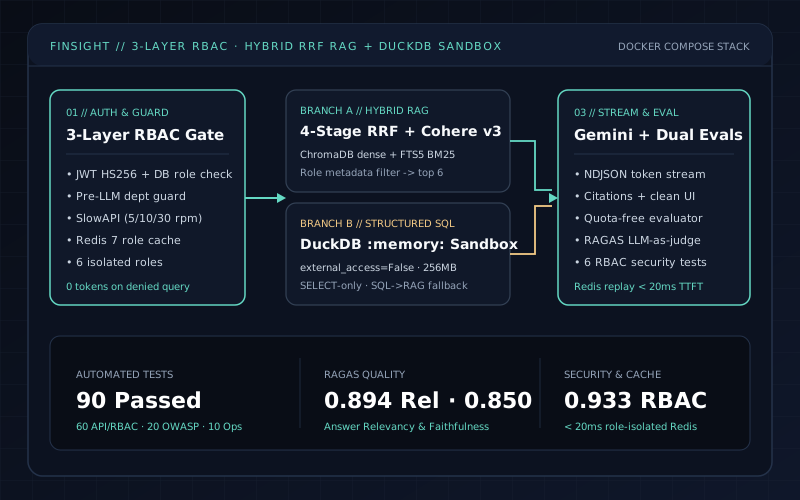
Layered engineering safeguards designed so no single model call is the sole boundary.
Layer 1 validates HS256 JWTs with per-request DB role re-validation (stale-token defense). Layer 2 blocks cross-department queries before the LLM runs. Layer 3 enforces ChromaDB role metadata filtering and DuckDB table whitelists.
3-way query expansion, concurrent ChromaDB dense vector search and SQLite FTS5 BM25 sparse search, Reciprocal Rank Fusion (k=60), and optional Cohere Rerank v3 — always citing source documents within the user's role.
LLM router classifies queries into RAG, SQL, or greeting with automatic SQL-to-RAG fallback. Generated SQL executes strictly in an in-memory DuckDB sandbox with external access disabled, SELECT-only enforcement, 10s timeout, and 1,000-row cap.
Role-scoped Redis cache (in-memory fallback) replays repeat queries under 20ms over NDJSON streams, defended by SlowAPI rate limits (/login 5/min, /upload-docs 10/min, /chat 30/min) and measured via RAGAS + quota-free eval pipelines.
Enterprise knowledge lives across siloed department reports and structured CSV spreadsheets. Off-the-shelf chat wrappers either hallucinate spreadsheet math or rely on prompt instructions for access control — risking payroll and financial leakage.
Built the entire vertical slice packaged with Docker Compose: FastAPI backend with 3-layer RBAC, 3-way query expansion + ChromaDB/FTS5/Cohere hybrid retrieval, LLM query router with automatic SQL-to-RAG fallback, isolated in-memory DuckDB SQL sandbox, role-scoped Redis cache (<20ms replay), tiered SlowAPI rate limiting, React 19 NDJSON streaming client, dual-track RAGAS + quota-free evals, and 90 automated tests.
Step through concrete scenarios to see how the system checks boundaries, reproduces failures, or degrades under quota pressure.
HR user: ‘Summarize the employee onboarding policy.’
Step 1 / 4
Verify JWT HS256 signature and re-validate current role in SQLite.
Key design choices, technical rationale, and accepted trade-offs behind the implementation.
Per-request JWT role re-validation, pre-LLM department guards, and ChromaDB/DuckDB store filters ensure unauthorized queries never reach the model or restricted data.
Combines dense semantic search with stdlib SQLite FTS5 BM25 keyword ranks using RRF (k=60), followed by optional Cohere reranking.
Copies only authorized CSV tables into an in-memory DuckDB connection (`enable_external_access=False`, SELECT-only, 10s timeout, 1,000-row cap) with automatic SQL-to-RAG fallback.
Watch the narrated system walkthrough below, or clone the repository to run the complete Docker Compose Full Stack (FastAPI + React + Redis) setup and automated test suite locally.
Getting enterprise AI into real workflows comes down to the unglamorous systems work: per-request access validation, sandboxed SQL execution, role-scoped caching, and 90 automated tests that prove boundaries hold.
Roles & Technical Collaboration
I’m open to full-time remote GenAI & AI Systems Engineering roles, as well as focused architecture and evaluation engagements.