3 Tiers
Inspect verification sourceAutomatic AI Failover
Graceful degradation from Gemini 2.5 Flash + Search -> Gemini 3.1 Flash Lite + Search -> Gemini 3.1 Flash Lite (Searchless) when model or search quotas return HTTP 429.
Deployment model: Web Serverless + Electron 36 Desktop
Deconstruct articles or URLs into atomic claims, verify against live Google Search, and degrade transparently across a 3-tier Gemini failover engine.
A full-stack information integrity platform (React 19, Express 4 / Vercel Serverless, and Electron 36 native desktop app) that isolates 2–4 checkable factual claims per input, grounds them against live Google Search, caches duplicate checks for 24 hours, and handles API/search rate limits via 3-tier automatic degradation.
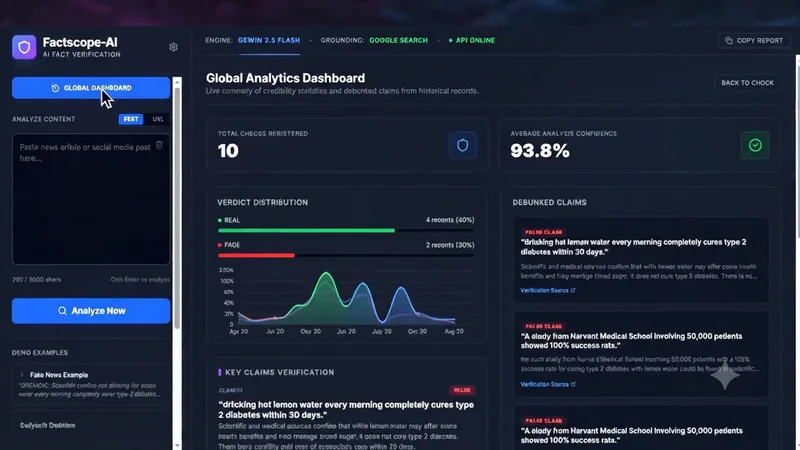
Repository-Backed Evidence
Graceful degradation from Gemini 2.5 Flash + Search -> Gemini 3.1 Flash Lite + Search -> Gemini 3.1 Flash Lite (Searchless) when model or search quotas return HTTP 429.
Caches duplicate raw text and URL requests for 24 hours in persistent storage (data/db.json), eliminating redundant Gemini API billing and latency.
Runs as a decoupled React 19 + Express / Vercel Serverless web app and as an Electron 36 native desktop client with local electron-store API key obfuscation, system tray, and dynamic port binding.
Classifies inputs into REAL, FAKE, MISLEADING, SATIRE, or UNVERIFIED with per-claim verdicts (TRUE, FALSE, CONTEXT_NEEDED, UNPROVEN), source citations, and contextual follow-up chat.
End-to-end dataflow and defensive isolation layers from request entry to verified output.
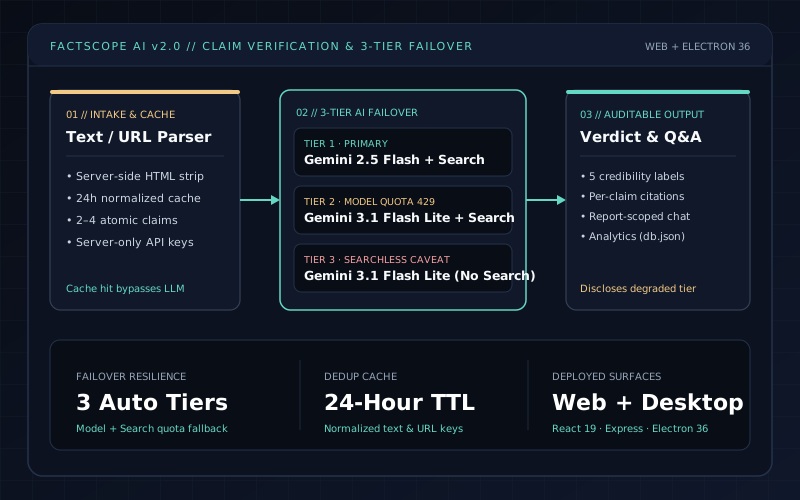
Layered engineering safeguards designed so no single model call is the sole boundary.
Strips scripts, styles, SVGs, and comments server-side without headless browsers, then decomposes prose into 2–4 discrete, checkable factual claims.
Verifies isolated claims against live Google Search citations and automatically steps down across 3 model/tool tiers when HTTP 429 or search quotas trip.
Injects full verification reports into a multi-turn follow-up chat, persists analytics in data/db.json, and packages cleanly as a native Electron 36 desktop app with server-only secret isolation.
Standard LLMs suffer from knowledge cutoffs and confidently hallucinate when asked to evaluate breaking news, while single-tier API integrations fail abruptly when model or search grounding quotas are exhausted.
Built the full-stack Factscope AI platform across both web and desktop: server-side HTML scraper, 3-tier Gemini failover engine with Google Search grounding, 24-hour normalized cache, contextual follow-up chat, analytics dashboard, security hardening (1MB payload caps, server-only keys, server-side UUIDs), and Electron 36 packaging.
Step through concrete scenarios to see how the system checks boundaries, reproduces failures, or degrades under quota pressure.
Breaking claim: ‘Scientists confirm that drinking hot lemon water cures type 2 diabetes within 30 days.’
Step 1 / 4
Isolate checkable factual propositions from viral phrasing.
Key design choices, technical rationale, and accepted trade-offs behind the implementation.
Isolates verifiable factual claims from rhetoric and scores each claim individually alongside an overall credibility label.
Steps down from Gemini 2.5 Flash + Search to Gemini 3.1 Flash Lite + Search, and finally searchless mode when search tooling itself is rate-limited.
Parses fetched URL HTML directly in Node/Express, stripping scripts, styles, and SVGs without Puppeteer or Playwright.
Watch the narrated system walkthrough below, or clone the repository to run the complete Web Serverless + Electron 36 Desktop setup and automated test suite locally.
Resilient AI products pair multi-tier failover and caching with radical UI honesty: when live grounding drops out, tell the user explicitly instead of presenting stale memory as verified fact.
Roles & Technical Collaboration
I’m open to full-time remote GenAI & AI Systems Engineering roles, as well as focused architecture and evaluation engagements.